What our clients say about us
“Another enjoyable trip to our excellent dentist today, always treat you with best of care and attention, recommend them to everyone in the county”


Missing teeth can affect more than just how your smile looks—they can affect the way you eat, speak and feel about your smile. If you have lost one or more teeth due to injury, decay or gum disease, dental implants in Oundle may be a suitable option for replacing them.
Dental implants are designed to provide stable support for replacement teeth and can be used in a variety of situations, from replacing a single tooth to supporting bridges or dentures.
At Townley House Dental Practice, we provide dental implant treatment in Oundle following a full clinical assessment to determine your suitability. Treatment is planned carefully and explained clearly so you can understand your options, including the potential benefits, risks, alternatives and likely treatment times.
A dental implant is a small titanium post that is surgically placed into the jawbone to replace the root of a missing tooth. Unlike removable dentures, an implant is anchored within the jawbone.
Following placement, the implant is given time to integrate with the surrounding bone through a process known as osseointegration. Once appropriate healing has taken place, a custom-made crown, bridge or denture can be attached to the implant to help restore appearance and function.
Dental implants may be used to:
Dental implants may offer several advantages compared with other tooth replacement options:
The suitability and expected benefits of implants vary between individuals. Alternative treatments, such as bridges or dentures, will also be discussed during your consultation.

Many adults with missing teeth may be considered for dental implants, but several factors need to be assessed before treatment.
These include:
As part of your assessment, we may take X-rays or 3D scans where clinically appropriate to evaluate the available bone and plan treatment.
If there is insufficient bone to support an implant, additional procedures such as bone grafting may sometimes be considered. If this applies to you, the reasons, risks and alternatives will be discussed in advance.
From the initial consultation through to the final restoration, our dental team in Oundle will work with you to create a treatment plan based on your individual clinical needs.
Dental implant treatment is usually carried out in several stages and may take a number of months, depending on your individual circumstances.
We review your medical history, assess your oral health and discuss your goals. X-rays or scans may be taken where necessary. Your treatment options, risks, benefits, alternatives and expected timeframe will be explained.
The titanium implant is surgically placed into the jawbone, usually under local anaesthetic. After the procedure, we will provide instructions to help support healing.
The implant is then allowed time to integrate with the surrounding bone. This process may take several weeks or months. A temporary restoration may be provided where appropriate.
Depending on the type of treatment, a small connector known as an abutment may be attached to the implant.
Once healing is satisfactory, a custom-made crown, bridge or denture is fitted to complete the restoration.
Treatment times vary depending on individual circumstances and whether any additional procedures are required.
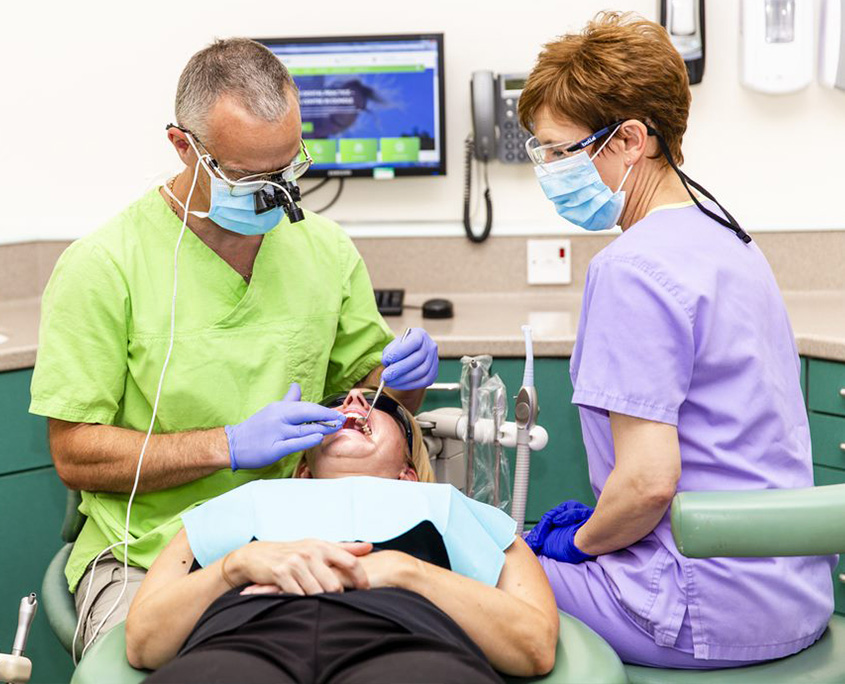
It is natural to be concerned about discomfort before implant treatment.
Implant placement is usually carried out under local anaesthetic to help keep you comfortable during the procedure. Some patients experience swelling, tenderness or discomfort afterwards, which is generally temporary.
This can often be managed with appropriate pain relief and aftercare. We will provide detailed instructions and arrange follow-up appointments where necessary.
Individual experiences and recovery times vary.
Dental implants may last for many years when properly maintained, but no dental treatment can be guaranteed to last indefinitely.
Their longevity can be affected by factors including:
Routine examinations, professional care and good oral hygiene at home all play an important role in maintaining implant health.
Looking after a dental implant is similar in many ways to caring for your natural teeth.
We generally recommend:
Good oral hygiene helps maintain the health of the tissues surrounding the implant and can support the longevity of your restoration.
Dental implants can be used in different ways depending on the number and position of missing teeth.
For example, implants may support:
The number of implants required and the most suitable type of restoration will depend on your oral health, available bone and individual treatment needs.
At Townley House Dental Practice, we will explain the different options and help you understand which may be appropriate for your circumstances and budget.
Living with missing teeth can affect eating, speech and confidence, and missing teeth may also lead to changes in the surrounding teeth and bone over time.
Dental implants in Oundle are one option for replacing missing teeth and may help restore function, appearance and stability.
The first step is a consultation at Townley House Dental Practice, where we can assess your oral health, discuss your goals and explain whether dental implant treatment may be suitable for you.
If you are considering dental implants near Oundle, please contact Townley House Dental Practice to arrange a consultation with our implant dentist in Oundle.

Email: [email protected]
Phone: 01832 272 515
